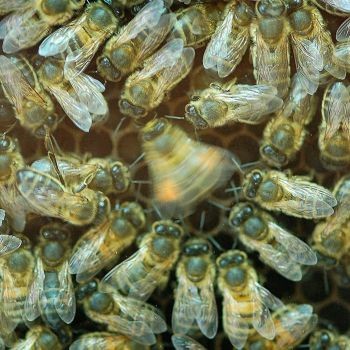
A honey bee waggle dances for nest mates in the hive
Dancing bees reveal why summer isn't the season of plenty. Summertime and the living is easy, we're told - but it's not so for the hungry honey bee, new research from the University of Sussex published this week (02 April 2014) reveals. Researchers from the University of Sussex Laboratory of Apiculture and Social Insects ( LASI ) spent two years filming honey bees in the lab's glass-fronted observation hives and then decoding their waggle dances to discover how far the bees were having to fly to find sources of food during different seasons. The bees were able to access the surrounding downland countryside and the nearby city of Brighton and Hove via tube tunnels that opened to the outside of the lab. The waggle dance is a unique behaviour found in honey bees, which a returning forager bee performs in the hive to tell its nest mates where to find good sources of pollen and nectar. The dance (in which the bee waggles its abdomen while moving in a figure of eight pattern) indicates the distance to a patch of flowers from the hive and the direction from the hive. By examining the waggle dance data, the researchers found that in summer, honey bees were covering areas 22 times greater than in spring and six times greater in the autumn.1 Honey bees are savvy foragers and will not waste valuable time and energy travelling if they don't need to, so the results show that summer is the most challenging season for collecting the nectar and pollen from flowers that bees use for food.
TO READ THIS ARTICLE, CREATE YOUR ACCOUNT
And extend your reading, free of charge and with no commitment.