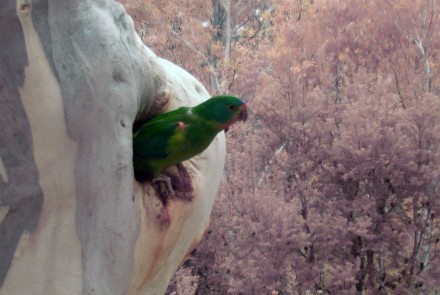
A female Swift Parrot.
New research has found the endangered Swift Parrot is more likely to be killed and eaten by Sugar Gliders in Tasmania in areas where forests are disturbed or lost compared to areas of intact forest. The research took place over a three-year period, and compared populations of Swift Parrots from mainland Tasmania where Sugar Gliders also live, to those on islands where Sugar Gliders are absent. "Across the Tasmanian mainland, we found a link between deforestation and increasing predation on parrot nests by Sugar Gliders," says chief investigator, ANU Postdoctoral Fellow and conservation biologist Dejan Stojanovic. "On offshore islands where Sugar Gliders are absent, no Swift Parrot nests failed due to predators, whereas on the Tasmanian mainland, Sugar Gliders caused the failure of 83 per cent of Swift Parrot nests, and in most cases, the adult female parrot was also killed and eaten." Stojanovic says his research found that in locations where forest loss was severe, predation on Swift Parrots and their nests could be as high as 100 per cent. However, survival of parrots and their nests improved as cover of old growth forest increased. "Our data suggest that when deforestation is minimal on the Tasmanian mainland, survival of Swift Parrot nests improves even when Sugar Gliders occur in the area," he said. The research is the first to document Sugar Gliders acting as the primary cause of mortality for any bird.
TO READ THIS ARTICLE, CREATE YOUR ACCOUNT
And extend your reading, free of charge and with no commitment.