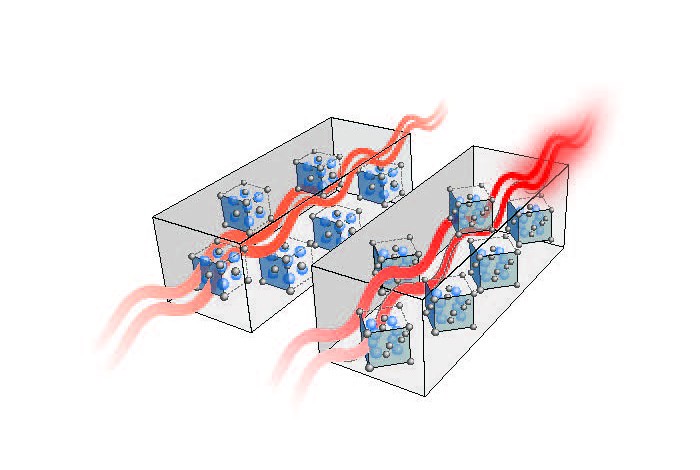
Illustration of anisotropic thermal conductivity in uranium dioxide. Scientists are studying the thermal conductivity related to the material’s different crystallographic directions, hoping to improve our understanding of uranium dioxide efficiency as reactor fuel.
New research is showing that the thermal conductivity of cubic uranium dioxide is strongly affected by interactions between phonons carrying heat and magnetic spins. "A deeper understanding of the physics that governs the performance of important engineering materials, such as uranium dioxide, should lead to improvements in efficiency and safety," said David Andersson. Reactor fuel behavior better understood with phonon insights. LOS ALAMOS, N.M. Aug. 4, 2014—Nearly 20 percent of the electricity in the United States is generated by nuclear energy from uranium dioxide fuel, but mysteries still surround exactly how the material controls the electrical production: Poor thermal conductivity can limit the conversion rate of heat produced by fission, however we don't know the physics underlying this behavior or, as it turns out, some of the properties to which it gives rise. "A deeper understanding of the physics that governs the performance of important engineering materials, such as uranium dioxide, should lead to improvements in efficiency and safety,” said David Andersson, a Los Alamos National Laboratory scientist on the project, "which are ultimate goals of the Department of Energy's program to develop advanced predictive computer models of nuclear reactor performance. New research at Los Alamos is showing that the thermal conductivity of cubic uranium dioxide is strongly affected by interactions between phonons carrying heat and magnetic spins.
TO READ THIS ARTICLE, CREATE YOUR ACCOUNT
And extend your reading, free of charge and with no commitment.