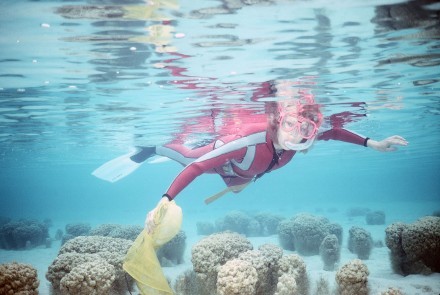
The late Dr Linda Moore sampling microbialites. Photo by Bob Burne.
Scientists have discovered that the earliest living organisms on Earth were capable of making a mineral that may be found on Mars. The clay-mineral stevensite has been used since ancient times and was used by Nubian women as a beauty treatment, but scientists had believed deposits could only be formed in harsh conditions like volcanic lava and hot alkali lakes. Researchers led by Dr Bob Burne from the ANU Research School of Earth Sciences have found living microbes create an environment that allows stevensite to form, raising new questions about the stevensite found on Mars. "It's much more likely that the stevensite on Mars is made geologically, from volcanic activity," Dr Burne said. "But our finding - that stevensite can form around biological organisms - will encourage re-interpretation of these Martian deposits and their possible links to life on that planet." Dr Burne and his colleagues from ANU, University of Western Australia and rock imaging company Lithicon, have found microbes can become encrusted by stevensite, which protects their delicate insides and provides the rigidity to allow them to build reef-like structures called "microbialites". "Microbialites are the earliest large-scale evidence of life on Earth," Dr Burne said. "They demonstrate how microscopic organisms are able to join together to build enormous structures that sometimes rivalled the size of today's coral reefs." He said the process still happens today in some isolated places like Shark Bay and Lake Clifton in Western Australia.
TO READ THIS ARTICLE, CREATE YOUR ACCOUNT
And extend your reading, free of charge and with no commitment.