Kathryn McGill
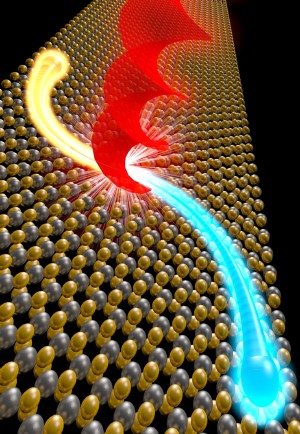
For the ever-shrinking transistor, there may be a new game in town. Cornell researchers have demonstrated promising electronic performance from a semiconducting compound with properties that could prove a worthy companion to silicon. New data on electronic properties of an atomically thin crystal of molybdenum disulfide are reported online in Science June 27 by Kin Fai Mak, a postdoctoral fellow at the Kavli Institute at Cornell for Nanoscale Science. His co-authors are Paul McEuen, the Goldwin Smith Professor of Physics; Jiwoong Park, associate professor of chemistry and chemical biology; and physics graduate student Kathryn McGill. Recent interest in molybdenum disulfide for transistors has been inspired in part by similar studies on graphene - one atom-thick carbon in an atomic formation like chicken wire. Although super strong, really thin and an excellent conductor, graphene doesn't allow for easy switching on and off of current, which is at the heart of what a transistor does. Molybdenum disulfide, on the other hand, is easy to acquire, can be sliced into very thin crystals and has the needed band gap to make it a semiconductor.
TO READ THIS ARTICLE, CREATE YOUR ACCOUNT
And extend your reading, free of charge and with no commitment.