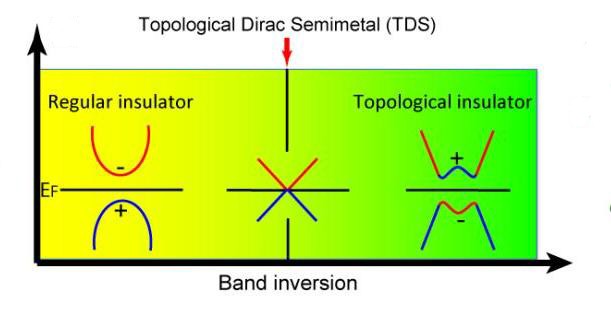
A topological Dirac semi-metal state is realized at the critical point in the phase transition from a normal insulator to a topological insulator. The + and - signs denote the even and odd parity of the energy bands.
The discovery of what is essentially a 3D version of graphene - the 2D sheets of carbon through which electrons race at many times the speed at which they move through silicon - promises exciting new things to come for the high-tech industry, including much faster transistors and far more compact hard drives. A collaboration of researchers at the U.S Department of Energy (DOE)'s Lawrence Berkeley National Laboratory (Berkeley Lab) has discovered that sodium bismuthide can exist as a form of quantum matter called a three-dimensional topological Dirac semi-metal (3DTDS). This is the first experimental confirmation of 3D Dirac fermions in the interior or bulk of a material, a novel state that was only recently proposed by theorists. "A 3DTDS is a natural three-dimensional counterpart to graphene with similar or even better electron mobility and velocity," says Yulin Chen, a physicist from the University of Oxford who led this study working with Berkeley Lab's Advanced Light Source (ALS) . "Because of its 3D Dirac fermions in the bulk, a 3DTDS also features intriguing non-saturating linear magnetoresistance that can be orders of magnitude higher than the materials now used in hard drives, and it opens the door to more efficient optical sensors." Chen is the corresponding author of a paper in Science reporting the discovery. The paper is titled "Discovery of a Three-dimensional Topological Dirac Semimetal, Na3Bi." Co-authors were Zhongkai Liu, Bo Zhou, Yi Zhang, Zhijun Wang, Hongming Weng, Dharmalingam Prabhakaran, Sung-Kwan Mo, Zhi-Xun Shen, Zhong Fang, Xi Dai and Zahid Hussain.
TO READ THIS ARTICLE, CREATE YOUR ACCOUNT
And extend your reading, free of charge and with no commitment.