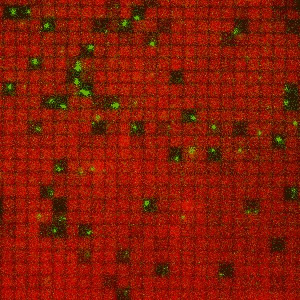
This gif of membrane-anchored Ras (red) and SOS molecules (green) shows individual SOS molecules corraled in nanofabricated patches where all the Ras molecules they activate can be trapped. (Click for animation)
A breakthrough discovery into how living cells process and respond to chemical information could help advance the development of treatments for a large number of cancers and other cellular disorders that have been resistant to therapy. An international collaboration of researchers, led by scientists with the U.S. Department of Energy (DOE)'s Lawrence Berkeley National Laboratory (Berkeley Lab) and the University of California (UC) Berkeley, have unlocked the secret behind the activation of the Ras family of proteins, one of the most important components of cellular signaling networks in biology and major drivers of cancers that are among the most difficult to treat. "Ras is a family of membrane-anchored proteins whose activation is a critical step in cellular signaling, but almost everything we know about how Ras signals are activated has been derived from bulk assays, in solution or in live cells, in which information about the role of the membrane environment and anything about variation among individual molecules is lost," says Jay Groves, a chemist with Berkeley Lab's Physical Biosciences Division and UC Berkeley's Chemistry Department. "Using a supported-membrane array platform, we were able to perform single molecule studies of Ras activation in a membrane environment and discover a surprising new mechanism though which Ras signaling is activated by Son of Sevenless (SOS) proteins." Groves, who is also a Howard Hughes Medical Institute (HHMI) investigator, is the corresponding author of a paper in Science that reports this discovery.
TO READ THIS ARTICLE, CREATE YOUR ACCOUNT
And extend your reading, free of charge and with no commitment.