Davis Lab
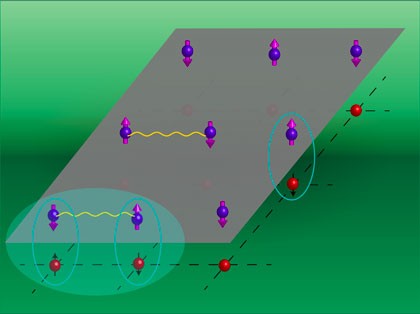
For decades, many physicists have taken for granted a theory that electrons in high-temperature superconductors are nudged into "Cooper pairs" that can carry an electric current without resistance by their interaction with the magnetic fields of nearby atoms. Sensitive measurements at Cornell have finally supplied the first experimental proof of the theory. Going further, researchers have shown that the magnetic interaction theory correctly predicts a wide variety of the properties of a superconductor. The discovery contributes to the quest for superconductors that would work at or near room temperature, creating a revolution in power transmission and electrical engineering: Maybe the answer is stronger magnetism. Superconductivity was first discovered in metals cooled almost to absolute zero (-273.15 degrees Celsius or -459. Fahrenheit). The explanation is that conducting electrons travel in pairs.
TO READ THIS ARTICLE, CREATE YOUR ACCOUNT
And extend your reading, free of charge and with no commitment.