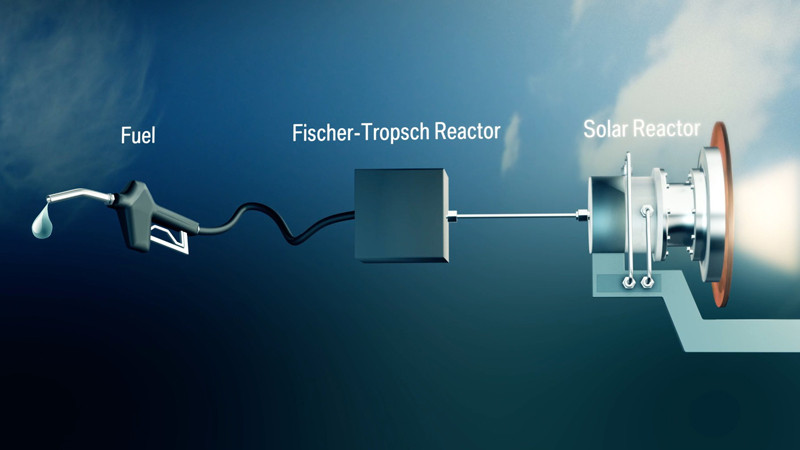
Artist’s rendering of the functional principle. (llustration: Solarjet)
In the framework of the EU-project Solarjet, scientists demonstrate for the first time the entire production path to liquid hydrocarbon fuels from water, CO2 and solar energy. The key technological component is a solar reactor developed at ETH Zurich. By playing this video, you agree to the use of cookies by YouTube This may include analytics, personalization, and ads. Learn more - OK A European consortium with the participation of ETH Zurich has experimentally demonstrated the first ever production of jet fuel via a thermochemical process using concentrated solar energy. Researchers from ETH Zurich conducted the EU funded project Solarjet together with the German Aerospace Center (DLR), the fuel company Shell, the think-tank Bauhaus Luftfahrt, and the consulting firm Arttic. The key component of the production process of sustainable "solar kerosene" is a high-temperature solar reactor developed by the group of Aldo Steinfeld, Professor of Renewable Energy Carriers at ETH Zurich and Head of the Solar Technology Laboratory at the Paul Scherrer Institute. The reactor contains a porous ceramic solar absorber made of the metal oxide ceria, which enables the molecular splitting of water and CO2 in a cyclic two-step reduction-oxidation (redox) process.
TO READ THIS ARTICLE, CREATE YOUR ACCOUNT
And extend your reading, free of charge and with no commitment.