Robinson group
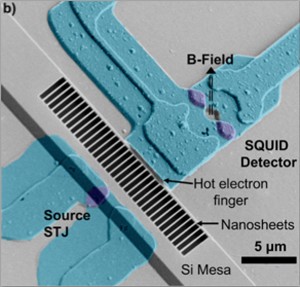
How heat flows at the nanoscale can be very different than at larger scales. Understanding how surfaces affect the transport of the fundamental units of heat, called phonons, could impact everything from thermoelectric materials to microelectronic cooling devices. Cornell researchers have developed a new way to precisely measure the extremely subtle movement of heat in nanostructures. Recently published online in Nano Letters and highlighted in Physics Today , the study features the researchers' phonon spectrometer, whose measurements are 10 times sharper than standard methods. This boosted sensitivity has uncovered never-before-seen effects of phonon transport. The scientists used the new instrument to directly measure the surface scattering of phonons in silicon nanosheets. They made nanosheets only 100 nanometers wide, which is 1,000 times thinner than a human hair, using special tools at the Cornell NanoScale Science and Technology Facility (CNF) - a key component in the success of their project, said senior author Richard Robinson, assistant professor of materials science and engineering.
TO READ THIS ARTICLE, CREATE YOUR ACCOUNT
And extend your reading, free of charge and with no commitment.