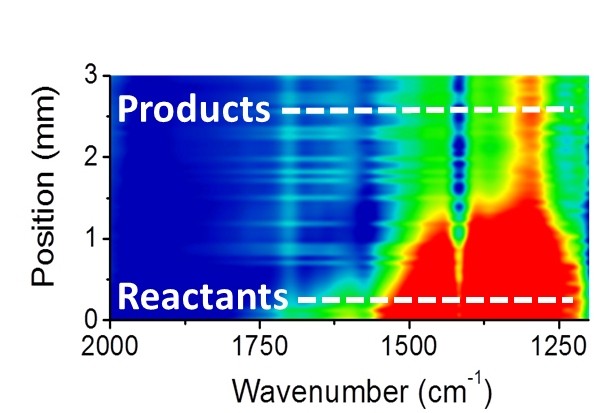
Inrared microspectroscopy scans can track the formation of different chemical products as reactants flow through a microreactor.
A pathway to more effective and efficient synthesis of pharmaceutical drugs and other flow reactor chemical products has been opened by a study in which for the first time the catalytic reactivity inside a microreactor was mapped in high resolution from start-to-finish. The results not only provided a better understanding of the chemistry behind the catalytic reactions, they also revealed opportunities for optimization, which resulted in better catalytic performances. The study was conducted by a team of scientists with the U.S. Department of Energy (DOE)'s Lawrence Berkeley National Laboratory (Berkeley Lab) and the University of California (UC) Berkeley. Working at Berkeley Lab's Advanced Light Source (ALS), the team, which was led by chemists Dean Toste and Gabor Somorjai, both of whom hold joint appointments with Berkeley Lab and UC Berkeley, used tightly focused beams of infrared and x-ray light to track the evolution of a catalytic reaction with a spatial resolution of 15 microns. "The formation of different chemical products during the reactions was analyzed using in situ infrared micro-spectroscopy, while the state of the catalyst along the flow reactor was determined using in situ x-ray absorption microspectroscopy," says Toste, a faculty scientist with Berkeley Lab's Chemical Sciences Division.
TO READ THIS ARTICLE, CREATE YOUR ACCOUNT
And extend your reading, free of charge and with no commitment.