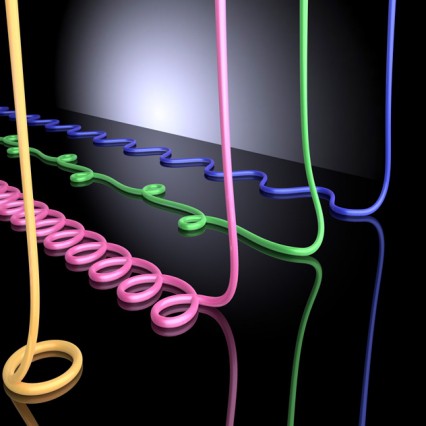
Researchers use numerical simulations to predict different patterns that may form as viscous threads fall onto a moving belt.
Drizzling honey on toast can produce mesmerizing, meandering patterns, as the syrupy fluid ripples and coils in a sticky, golden thread. Dribbling paint on canvas can produce similarly serpentine loops and waves. The patterns created by such viscous fluids can be reproduced experimentally in a setup known as a "fluid mechanical sewing machine," in which an overhead nozzle deposits a thick fluid onto a moving conveyor belt. Researchers have carried out such experiments in an effort to identify the physical factors that influence the patterns that form. Now a group of mathematicians at MIT, Cambridge University, and elsewhere have developed a simple model to predict patterns formed by viscous fluids as they fall onto a moving surface. The researchers looked at four patterns - sinusoidal waves; repeating and alternating loops; and straight lines - and observed that the pattern formed depends on the ratio between the fluid's speed on impact and the speed of the conveyor belt. The team found that this ratio influences a fluid's shape, or curvature, just before hitting the surface, which in turn determines the pattern that forms.
TO READ THIS ARTICLE, CREATE YOUR ACCOUNT
And extend your reading, free of charge and with no commitment.