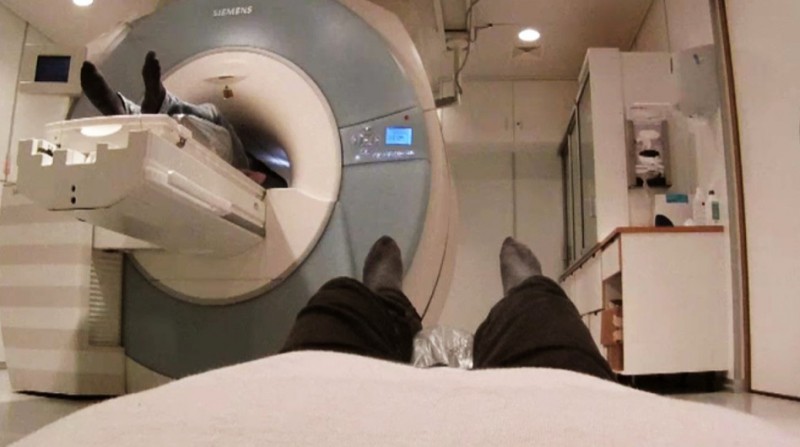
Credit: Arvid Guterstam.
The feeling of being inside one's own body is not as self-evident as one might think. In a new study from Sweden's Karolinska Institutet, neuroscientists created an out-of-body illusion in participants placed inside a brain scanner. They then used the illusion to perceptually 'teleport' the participants to different locations in a room and show that the perceived location of the bodily self can be decoded from activity patterns in specific brain regions. The sense of owning one's body and being located somewhere in space is so fundamental that we usually take it for granted. To the brain, however, this is an enormously complex task that requires continuous integration of information from our different senses in order to maintain an accurate sense of where the body is located with respect to the external world. Studies in rats have shown that specific regions of the brain contain GPS-like 'place cells' that signal the rat's position in the room - a discovery that was awarded the 2014 Nobel Prize in Physiology or Medicine. To date, however, it remains unknown how the human brain shapes our perceptual experience of being a body somewhere in space, and whether the regions that have been identified in rats are involved in this process.
TO READ THIS ARTICLE, CREATE YOUR ACCOUNT
And extend your reading, free of charge and with no commitment.