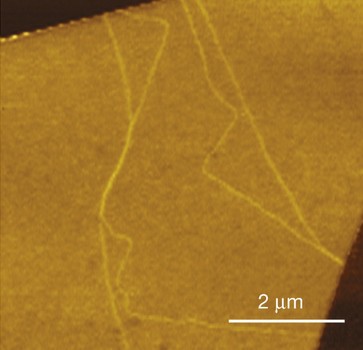
In this near-field infrared nanoscopy image of bilayer graphene obtained at the Advanced Light Source, domain walls are revealed by bright lines that arise because of the walls’ electronic structures and IR responses.
To the list of potential applications of graphene - a two-dimensional semiconductor of pure carbon that is stronger and much faster than silicon - we can now add valleytronics, the coding of data in the wavelike motion of electrons as they speed through a conductor. Berkeley Lab researchers have discovered topologically protected one-dimensional electron conducting channels at the domain walls of bilayer graphene. These conducting channels are "valley polarized," which means they can serve as filters for electron valley polarization in future devices such as quantum computers. "Combining near-field infrared nanometer-scale microscopy and low-temperature electrical transport measurements, we have recorded the first experimental observations of 1D ballistic electron conducting channels at bilayer graphene domain walls," says Feng Wang, a condensed matter physicist with Berkeley Lab's Materials Sciences Division, who led this work. "These 1D valley-polarized conducting channels featured a ballistic length of about 400 nanometers at 4 kelvin. Their existence opens up opportunities for exploring unique topological phases and valley physics in graphene." Wang, who also holds an appointment with the University of California (UC) Berkeley Physics Department, is the corresponding author of a paper describing this research in the journal Nature . The lead authors of the paper are Long Ju and Zhiwen Shi, members of Wang's research group.
TO READ THIS ARTICLE, CREATE YOUR ACCOUNT
And extend your reading, free of charge and with no commitment.