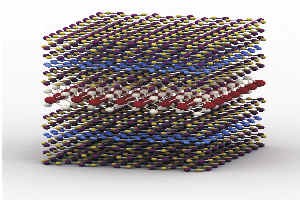
LED Heterostructure Schematic
Semi-transparent, flexible electronics are no longer just science-fiction thanks to graphene's unique properties, University of Manchester researchers have found. Published in the scientific , University of Manchester and University of Sheffield researchers show that new 2D 'designer materials' can be produced to create flexible, see-through and more efficient electronic devices. The team, led by Nobel Laureate Sir Kostya Novoselov, made the breakthrough by creating LEDs which were engineered on an atomic level. The new research shows that graphene and related 2D materials could be utilised to create light emitting devices for the next-generation of mobile phones, tablets and televisions to make them incredibly thin, flexible, durable and even semi-transparent. The LED device was constructed by combining different 2D crystals and emits light from across its whole surface. Being so thin, at only 10-40 atoms thick, these new components can form the basis for the first generation of semi-transparent smart devices. One-atom thick graphene was first isolated and explored in 2004 at The University of Manchester.
TO READ THIS ARTICLE, CREATE YOUR ACCOUNT
And extend your reading, free of charge and with no commitment.