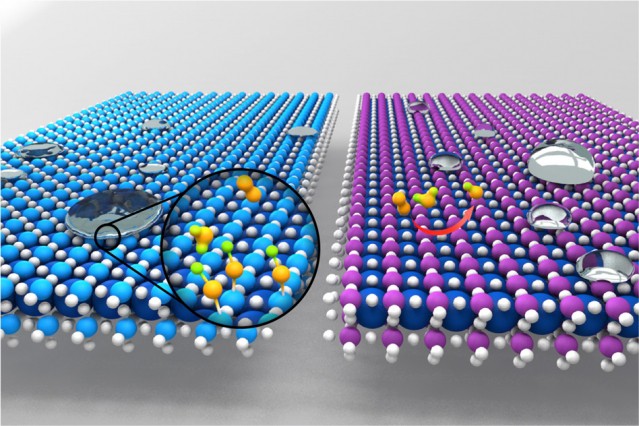
Materials that have good wetting properties, as illustrated on the left, where droplets spread out flat, tend to have hydroxyl groups attached to the surface, which inhibits catalytic activity. Materials that repel water, as shown at right, where droplets form sharp, steep boundaries, are more conducive to catalytic activity, as shown by the reactions among small orange molecules.
Two key physical phenomena take place at the surfaces of materials: catalysis and wetting. A catalyst enhances the rate of chemical reactions; wetting refers to how liquids spread across a surface. Now researchers at MIT and other institutions have found that these two processes, which had been considered unrelated, are in fact closely linked. The discovery could make it easier to find new catalysts for particular applications, among other potential benefits. "What's really exciting is that we've been able to connect atomic-level interactions of water and oxides on the surface to macroscopic measurements of wetting, whether a surface is hydrophobic or hydrophilic, and connect that directly with catalytic properties," says Yang Shao-Horn, the W.M. Keck Professor of Energy at MIT and a senior author of a paper describing the findings in the Journal of Physical Chemistry C . The research focused on a class of oxides called perovskites that are of interest for applications such as gas sensing, water purification, batteries, and fuel cells. Since determining a surface's wettability is "trivially easy," says senior author Kripa Varanasi, an associate professor of mechanical engineering, that determination can now be used to predict a material's suitability as a catalyst.
TO READ THIS ARTICLE, CREATE YOUR ACCOUNT
And extend your reading, free of charge and with no commitment.