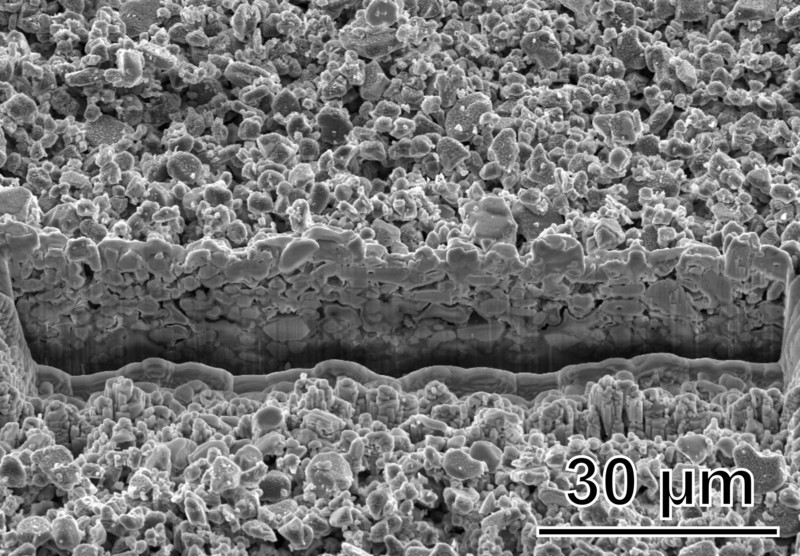
New etching technique created a porous surface with higher emission.
[ Florian Aigner - Nanostructures etched into the surface: TU Wien develops a new processing technology to improve the electrical properties of glass ceramic circuit boards - As you ease your foot off the accelerator, a radar sensor detects how far away you are from the other cars and intelligently adjusts your speed appropriately. Technology like this is already helping to improve road safety and is set to become even more commonplace. From an electrical engineering perspective, manufacturing sensors of this kind is an extremely tricky process: the sensors have to be able to operate at very high frequencies but still need to be precise and efficient. TU Wien has now managed to develop a new processing technology for the high-precision nanostructuring of glass ceramic circuit boards. This means that the material properties can be adjusted, thereby significantly improving the electromagnetic behaviour of the sensor. The material affects the radiation properties Radar sensor antennas have very little in common with the metal rods that you might see protruding from a radio set. That is because today's sensor antennas are extremely compact and mounted directly onto the circuit boards.
TO READ THIS ARTICLE, CREATE YOUR ACCOUNT
And extend your reading, free of charge and with no commitment.