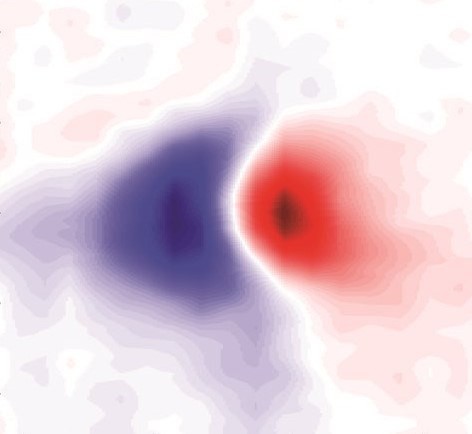
A study has shown that the optical Stark effect, which describes the energy shift in a two-level system induced by a non-resonant laser field, can be used to control valley excitons in MX2 semiconductors.
A potential avenue to quantum computing currently generating quite the buzz in the high-tech industry is "valleytronics," in which information is coded based on the wavelike motion of electrons moving through certain two-dimensional (2D) semiconductors. Now, a promising new pathway to valleytronic technology has been uncovered by researchers with the Lawrence Berkeley National Laboratory (Berkeley Lab). Feng Wang, a condensed matter physicist with Berkeley Lab's Materials Sciences Division, led a study in which it was demonstrated that a well-established phenomenon known as the "optical Stark effect" can be used to selectively control photoexcited electrons/hole pairs - referred to as excitons -in different energy valleys. In valleytronics, electrons move through the lattice of a 2D semiconductor as a wave with two energy valleys, each valley being characterized by a distinct momentum and quantum valley number. This quantum valley number can be used to encode information when the electrons are in a minimum energy valley. The technique is analogous to spintronics, in which information is encoded in a quantum spin number. "This is the first demonstration of the important role the optical Stark effect can play in valleytronics," Feng says.
TO READ THIS ARTICLE, CREATE YOUR ACCOUNT
And extend your reading, free of charge and with no commitment.