Lionel Levine
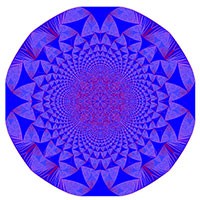
The Apollonian circle packing fractal is a quantification of the sandpile fractal's ability to remember that it used to live on a square grid. To humor mathematicians, picture a pile of sand grains - say, a billion - in one square of a vast sheet of graph paper. If four or more grains occupy a single square, that square topples by sending one grain to each of its four neighboring squares. Keep zooming out so the squares become very small, and something strange happens - the sand still "remembers" that it used to live on a square lattice, and a distinctive pattern emerges. Beautiful to boot, this phenomenon, which has stumped mathematicians for decades, is called the Abelian sandpile fractal. Cornell mathematicians offer a new way of seeing this fractal, by quantifying how its formation depends on that original square grid. This quantification might reveal new insights into the concept of "self-organized criticality," which is when a few simple rules result in complex patterns.
TO READ THIS ARTICLE, CREATE YOUR ACCOUNT
And extend your reading, free of charge and with no commitment.