Davis lab
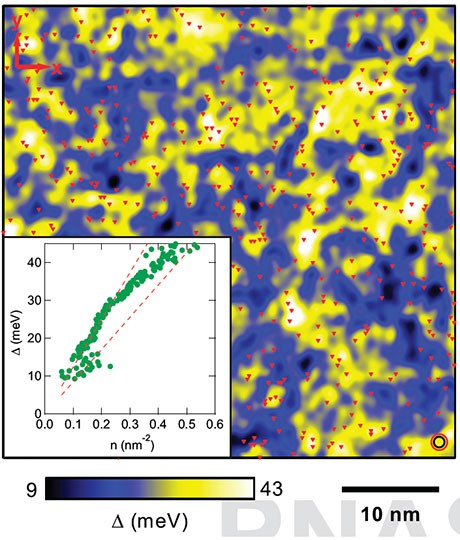
Exotic new materials called "ferromagnetic topological insulators" were supposed to be the next big thing, offering potential breakthroughs in electronics and new insights into the physics of solids - but it hasn't happened. Researchers at Cornell and Brookhaven National Laboratory have found out that tinkering with the materials to make the insulators work has actually introduced a disorder that spoils the desired effects. Their discovery is reported in the Feb. 3 edition of the Proceedings of the National Academy of Sciences. Topological insulators are insulators in bulk, but an electric current flows smoothly on their surface. "They are very weird compounds with a conducting sheen one electron thick," explained J.C. Seamus Davis, Cornell's James Gilbert White Distinguished Professor in the Physical Sciences and a senior physicist at Brookhaven. "For five or more years people have been trying to develop all the exotic potential, but with very few results." Theorists predicted that topological insulators might be used in new kinds of electronic devices, including quantum computers, and that they could display unusual physical phenomena, including simulations of magnetic monopoles or of axions - particles theorized to be associated with dark matter.
TO READ THIS ARTICLE, CREATE YOUR ACCOUNT
And extend your reading, free of charge and with no commitment.