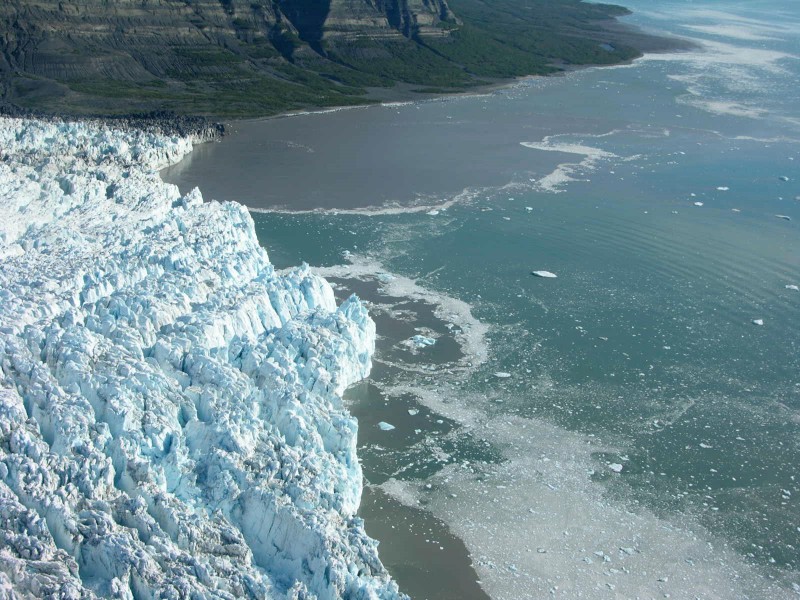
The brown water that can be seen at the top of the picture is the subglacial discharge, or meltwater, that has flowed through Alaska’s Yahtse Glacier and into the ocean. Scientists at The University of Texas at Austin have pioneered a method to track meltwater flowing through glaciers that end in the ocean.
AUSTIN, Texas - Researchers for the first time have used seismic sensors to track meltwater flowing through glaciers and into the ocean, an essential step to understanding the future of the world's largest glaciers as climate changes. The University of Texas Institute for Geophysics (UTIG) helped pioneer this new method on glaciers in Greenland and Alaska. The study will be published Aug. 10 in the journal Geophysical Research Letters . Meltwater moving through a glacier into the ocean is critically important because it can increase melting and destabilize the glacier in a number of ways: The water can speed the glacier's flow downhill toward the sea; it can move rocks, boulders and other sediments toward the terminus of the glacier along its base; and it can churn and stir warm ocean water, bringing it in with the glacier. "It's like when you drop an ice cube into a pot of warm water. It will eventually melt, but it will melt a lot faster if you stir that water," said Timothy Bartholomaus, a postdoctoral fellow at UTIG and the study's lead author.
TO READ THIS ARTICLE, CREATE YOUR ACCOUNT
And extend your reading, free of charge and with no commitment.