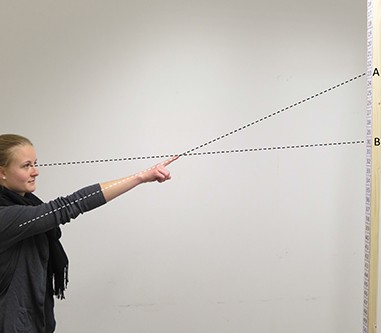
Die meisten Betrachter glauben, dass die Person etwa an Position A zeigt. Tatsächlich wurde sie instruiert, an Position B zu zeigen. Die Linien verdeutlichen wie Zeigegesten interpretiert und produziert werden. ( Uni Würzburg/Herbort)
11/16/2015 - Everyone probably knows the following situation: You point your finger at something to show it to someone else. But the other person does not get it, sees neither the hedgehog by the road, nor a certain constellation in the sky. Psychologists from the University of Würzburg have found out why pointing gestures are frequently misunderstood. Pointing gestures are an important part of interpersonal communication. But communication by pointing reaches its limits once you are pointing at inconspicuous objects at a distance. In that case, observers of pointing gestures frequently do not understand what the other person is pointing at. Psychologist Oliver Herbort from the University of Würzburg has conducted an experiment to investigate the reasons of this phenomenon.
TO READ THIS ARTICLE, CREATE YOUR ACCOUNT
And extend your reading, free of charge and with no commitment.