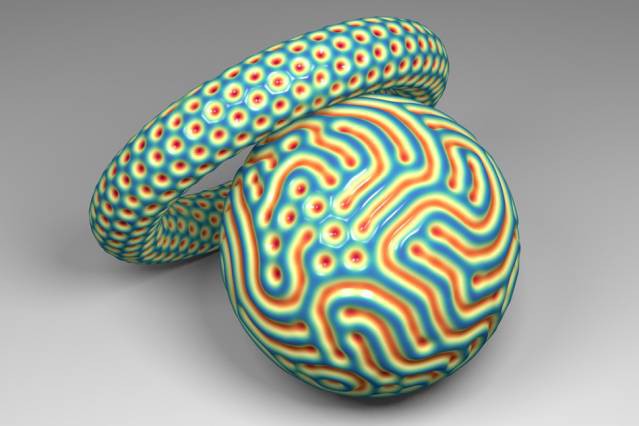
MIT researchers have developed a mathematical equation that predicts how surface patterns form on curved objects. Pictured is a sphere with a combination of hexagons and labyrinthine patterns, and a more complex, torus-shaped object with hexagonal dimples.
As a grape slowly dries and shrivels, its surface creases, ultimately taking on the wrinkled form of a raisin. Similar patterns can be found on the surfaces of other dried materials, as well as in human fingerprints. While these patterns have long been observed in nature, and more recently in experiments, scientists have not been able to come up with a way to predict how such patterns arise in curved systems, such as microlenses. Now a team of MIT mathematicians and engineers has developed a mathematical theory, confirmed through experiments, that predicts how wrinkles on curved surfaces take shape. From their calculations, they determined that one main parameter - curvature - rules the type of pattern that forms: The more curved a surface is, the more its surface patterns resemble a crystal-like lattice. The researchers say the theory, reported this week , may help to generally explain how fingerprints and wrinkles form. "If you look at skin, there's a harder layer of tissue, and underneath is a softer layer, and you see these wrinkling patterns that make fingerprints," says Jörn Dunkel, an assistant professor of mathematics at MIT.
TO READ THIS ARTICLE, CREATE YOUR ACCOUNT
And extend your reading, free of charge and with no commitment.