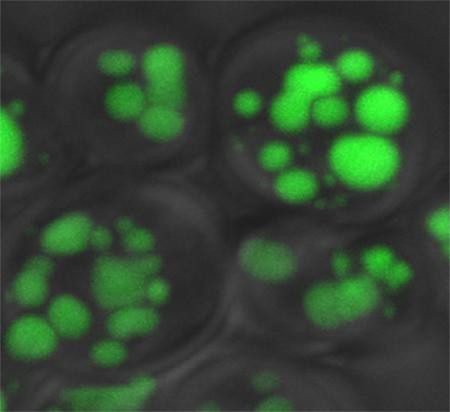
The "fatter" yeast cells that have had SNF4 knocked out. The larger fat droplets are colored green.
A team of biologists and a mathematician have identified and characterized a network composed of 94 proteins that work together to regulate fat storage in yeast. "Removal of any one of the proteins results in an increase in cellular fat content, which is analogous to obesity," says study coauthor Bader Al-Anzi, a research scientist at Caltech. The findings, detailed in the May issue of the journal PLOS Computational Biology , suggest that yeast could serve as a valuable test organism for studying human obesity. "Many of the proteins we identified have mammalian counterparts, but detailed examinations of their role in humans has been challenging," says Al-Anzi. "The obesity research field would benefit greatly if a single-cell model organism such as yeast could be used-one that can be analyzed using easy, fast, and affordable methods." Using genetic tools, Al-Anzi and his research assistant Patrick Arpp screened a collection of about 5,000 different mutant yeast strains and identified 94 genes that, when removed, produced yeast with increases in fat content, as measured by quantitating fat bands on thin-layer chromatography plates. Other studies have shown that such "obese" yeast cells grow more slowly than normal, an indication that in yeast as in humans, too much fat accumulation is not a good thing. "A yeast cell that uses most of its energy to synthesize fat that is not needed does so at the expense of other critical functions, and that ultimately slows down its growth and reproduction," Al-Anzi says.
TO READ THIS ARTICLE, CREATE YOUR ACCOUNT
And extend your reading, free of charge and with no commitment.