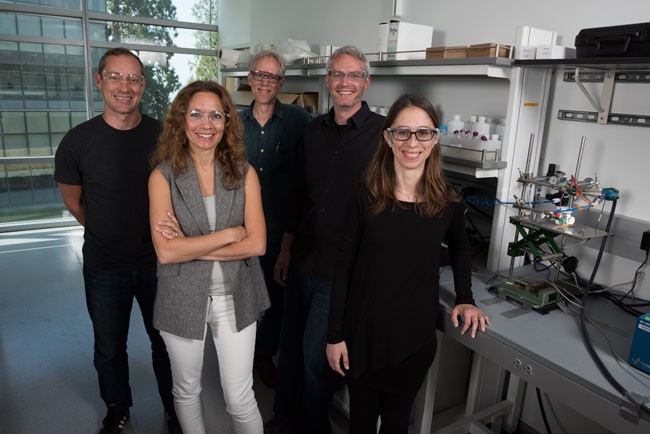
Berkeley Lab scientists at DOE’s Joint Center for Artificial Photosynthesis are working to improve systems that efficiently convert sunlight, water and carbon dioxide into fuel. Shown (left to right) are David Larson, Kristin Persson, Jeff Beeman, Ian Sharp, and Francesca Toma. (Credit: Paul Mueller/Berkeley Lab)
Mimicking nature is not easy, but new insights by researchers at the Department of Energy's Lawrence Berkeley National Laboratory (Berkeley Lab) could help create a viable artificial system of photosynthesis. One of the major challenges for scientists working to create systems that efficiently convert sunlight, water and carbon dioxide into fuel is finding materials that can do the work while also surviving the corrosive conditions that are part of the process. Existing methods to determine material stability have been hit and miss, but a Berkeley Lab-led research team has applied a combination of experimental and theoretical tools to rigorously determine how well a material will weather the harsh environments present in these systems. The researchers, part of DOE's Joint Center for Artificial Photosynthesis (JCAP), describe "None of the existing methods to predict material stability were working,” said study lead author Francesca Toma, a Berkeley Lab staff scientist in the Chemical Sciences Division. "We need to develop a set of techniques that could give us a more accurate assessment of how a material will behave in real-world applications. How can we figure out if this material is going to last 10 years? Having methods that allow us to understand how a material degrades and to predict its stability over the years is an important advance." Artificial photosynthesis has a way to go to achieve the controlled, stable process of its natural counterpart. A key step in both natural and artificial photosynthesis is the splitting of water into its constituents, hydrogen and oxygen.
TO READ THIS ARTICLE, CREATE YOUR ACCOUNT
And extend your reading, free of charge and with no commitment.