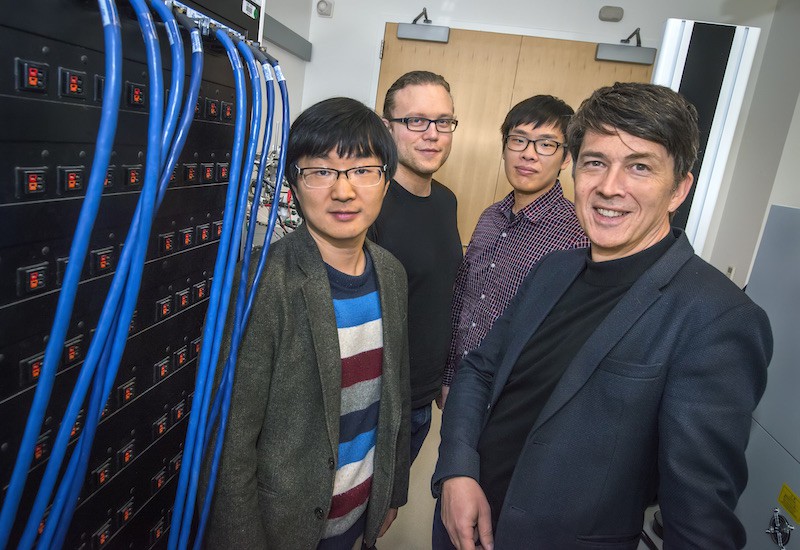
A new study by Berkeley Lab researchers Dong-Hwa Seo, Alex Urban, Jinhyuk Lee, and Gerd Ceder (from left) sheds light on how lithium-rich cathodes work, opening the door to higher capacity batteries. (Credit: Roy Kaltschmidt/Berkeley Lab)
Berkeley Lab researchers shed light on how lithium-rich cathodes work, opening the door to higher capacity batteries. In the quest for a radically better lithium-ion battery, a promising direction is the so-called "lithium-rich" cathode, in which the cathode contains a higher proportion of lithium than normal. While it has the potential to have far higher energy density, scientists have lacked a clear picture of the chemical processes, especially the role of oxygen. Now researchers at the Department of Energy's (DOE) Lawrence Berkeley National Laboratory (Berkeley Lab) report a major advance in understanding how oxygen oxidation creates extra capacity in such cathodes, opening the door to batteries with far higher energy density, meaning your phone or electric vehicle will be able to run for much longer between charges. "The specific nature of our findings shows a clear and exciting path forward to create the next-generation cathode materials with substantially higher energy density then current cathode materials," the researchers write in their study titled, "The structural and chemical origin of the oxygen redox activity in layered and cation-disordered Li-excess cathode materials," published online . The research was led by Gerbrand Ceder of Berkeley Lab's Materials Sciences Division. The lead authors were Dong-Hwa Seo and Jinhyuk Lee, and other co-authors were Alexander Urban, Rahul Malik, and ShinYoung Kang.
TO READ THIS ARTICLE, CREATE YOUR ACCOUNT
And extend your reading, free of charge and with no commitment.