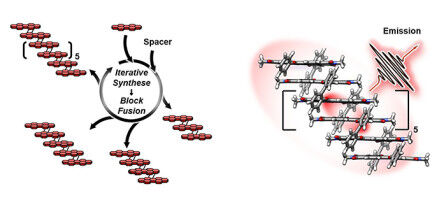
Newly discovered light harvesting properties could lead to cheaper solar panels
Researchers have discovered that some solar cells could be more efficient than previously thought possible, opening new doors for their development. A team led by scientists from Imperial College London have revealed how a particular molecular structure can boost the effectiveness of polymer solar cells. We're hoping that companies and other researchers developing new solar panel technologies can use this idea to develop materials in new ways. Most solar cells in use today are made of silicon, but cells constructed of polymer plastics are lighter and cheaper to produce. Despite this, they are not currently widely adopted because they do not convert light into electrical energy as efficiently. However, a new study, published in Nature Materials this month, provides an important insight into creating more absorptive and more efficient polymer solar panels. Improving solar cells' efficiency relies on altering the materials to absorb more wavelengths of light, extending beyond just the visible spectrum.