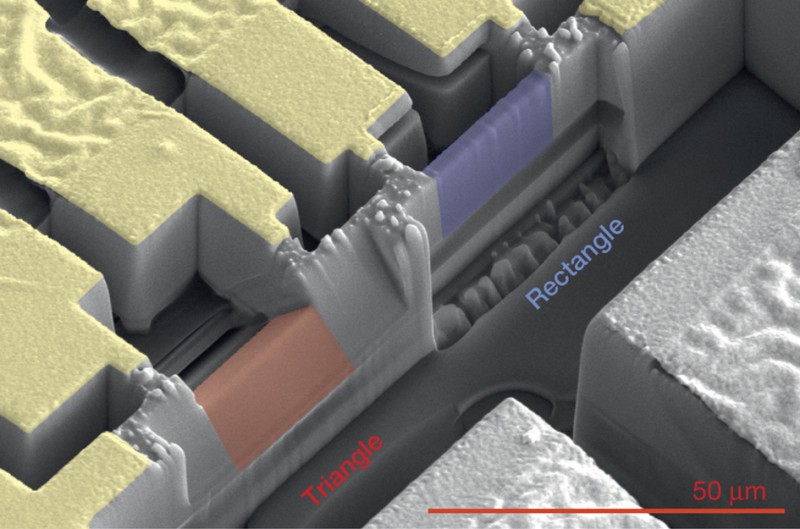
A scanning electron microscope image shows triangular (red) and rectangular (blue) samples of a semimetal crystal known as cadmium arsenide. The rectangular sample is about 0.8 microns (thousandths of a millimeter) thick, 3.2 microns tall and 5 microns long. The triangular sample has a base measuring about 2.7 microns. The design of the triangular samples, fabricated at Berkeley Lab’s Molecular Foundry, proved useful in mapping out the strange electron orbits exhibited by this material when exposed to a magnetic field. The red scale bar at lower right is 50 microns. (Credit: Nature, 10.1038/nature18276)
Researchers have created an exotic 3-D racetrack for electrons in ultrathin slices of a nanomaterial they fabricated at the Department of Energy's Lawrence Berkeley National Laboratory (Berkeley Lab). The international team of scientists from Berkeley Lab, UC Berkeley, and Germany observed, for the first time, a unique behavior in which electrons rotate around one surface, then through the bulk of the material to its opposite surface and back. The possibility of developing so-called 'topological matter? that can carry electrical current on its surface without loss at room temperature has attracted significant interest in the research community. The ultimate goal is to approach the lossless conduction of another class of materials, known as superconductors, but without the need for the extreme, freezing temperatures that superconductors require. 'Microchips lose so much energy through heat dissipation that it's a limiting factor,' said James Analytis, a staff scientist at Berkeley Lab and assistant professor of physics at UC Berkeley who led 'The smaller they become, the more they heat up.' The studied material, an inorganic semimetal called cadmium arsenide (Cd3As2), exhibits quantum properties'which are not explained by the classical laws of physics'that offer a new approach to reducing waste energy in microchips. In 2014, scientists discovered that cadmium arsenide shares some electronic properties with graphene, a single-atom-thick material also eyed for next-generation computer components, but in a 3-D form.
TO READ THIS ARTICLE, CREATE YOUR ACCOUNT
And extend your reading, free of charge and with no commitment.