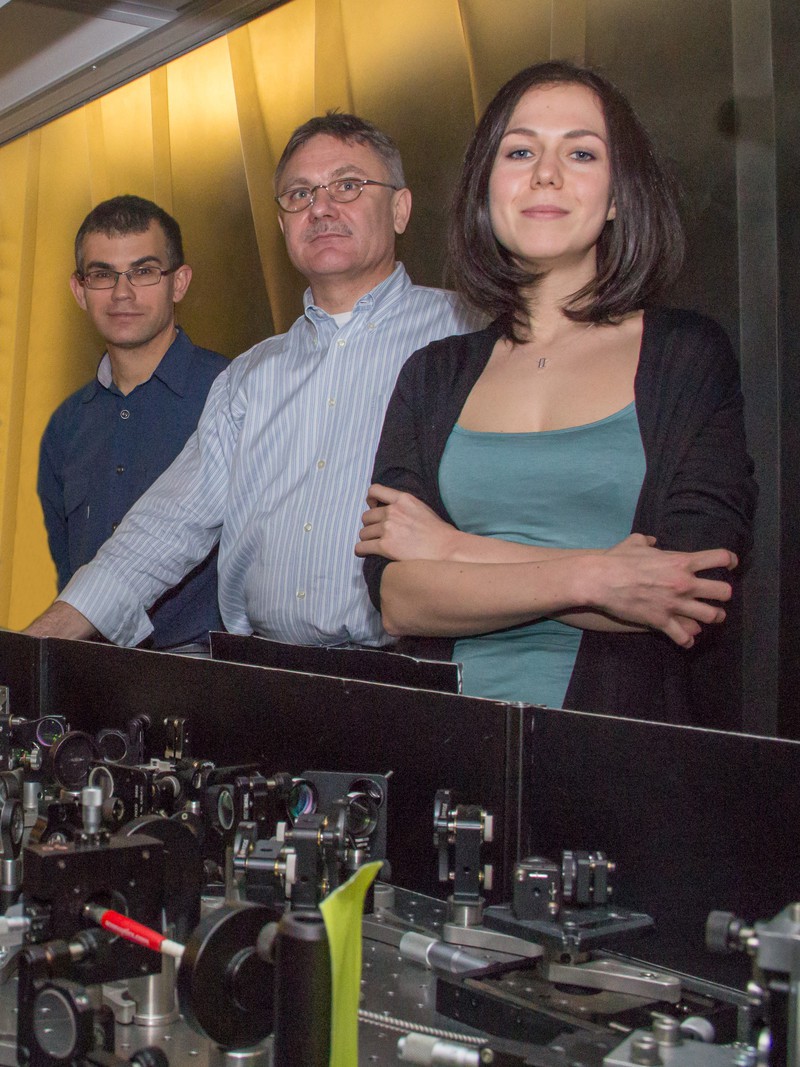
Andrius Baltuska, Audrius Pugzlys, Valentina Shumakova (v.l.n.r)
Scientists at TU Wien (Vienna) found a way to compress ultrashort laser pulses, increasing its peak power to half a terawatt - which is equivalent to the output of hundreds of nuclear reactors. It is a very unusual kind of laser: researchers at the photonics institute at TU Wien (Vienna) have built a device which emits ultrashort flashes of infrared light with extremely high energy. 'It is very hard to combine these three properties - long infrared wavelength, short duration and high energy', says Valentina Shumakova. 'But this combination is exactly what we need for many interesting strong-field applications.' - Now the team has achieved a major breakthrough: By sending very energetic pulses in the infrared regime through a solid medium, the pulses can be compressed in time and space. The energy stays roughly the same, but it can now be deposited in an even shorter period of time, resulting in an incredible peak power of up to half a terawatt. This power corresponds to the output of hundreds of nuclear reactors. But unlike power plants, which produce the power steadily, the compressed laser pulse only lasts 30 femtoseconds (millionths of a billionth of a second).
TO READ THIS ARTICLE, CREATE YOUR ACCOUNT
And extend your reading, free of charge and with no commitment.