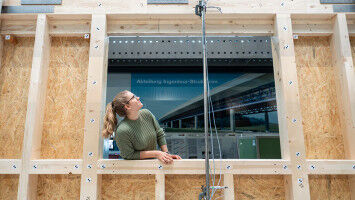
At the pilot plant for additive manufacturing, a multi-functional wall element is produced. Bachelor student Bettina Saile fills the test extruder with fresh concrete. (Photo: K. Henke / TUM)
Research news - Concrete components are traditionally made by casting. But the mold needed places significant limitations on design possibilities. 3D printing now provides new freedom in shaping. Researchers at the Technical University of Munich (TUM) are experimenting with various processes, including selective binding. This technology has made it possible for the first time to create intricate, bionic structures from real concrete. From tailor-made implants to weight-optimized aircraft and automobile parts: 3D printing has already become an everyday technology in many industry segments. And it's high time that architecture can benefit from 3D printing as well, says Dr. Klaudius Henke of the TUM Chair of Timber Structures and Building Construction : "Additive manufacturing is extremely attractive for construction: It enables a wide range of shapes at high levels of cost-efficiency, even in small batch sizes." - Printed concrete - Just as good as the mold.
TO READ THIS ARTICLE, CREATE YOUR ACCOUNT
And extend your reading, free of charge and with no commitment.