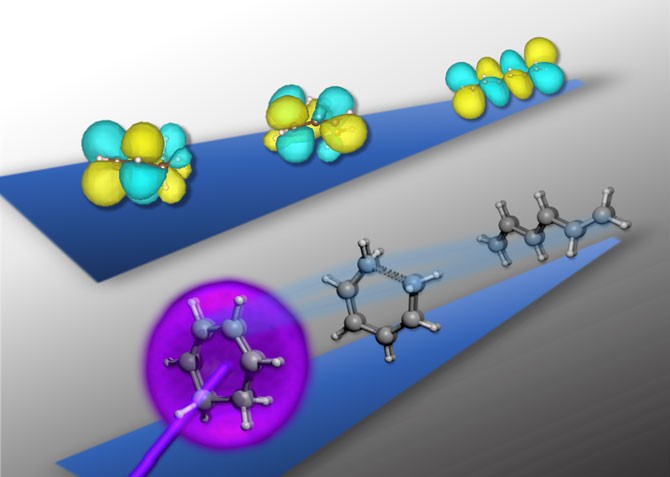
Upon light activation (in purple, bottom row’s ball-and-stick diagram), the cyclic structure of the 1,3-cyclohexadiene molecule rapidly unravels into a near-linear shape in just 200 femtoseconds. Using ultrafast X-ray spectroscopy, researchers have captured in real time the accompanying transformation of the molecule’s outer electron "clouds” (in yellow and teal, top row’s sphere diagram) as the structure unfurls. (Credit: Kristina Chang/Berkeley Lab)
The ephemeral electron movements in a transient state of a reaction important in biochemical and optoelectronic processes have been captured and, for the first time, directly characterized using ultrafast X-ray spectroscopy at the Department of Energy's Lawrence Berkeley National Laboratory (Berkeley Lab). Like many rearrangements of molecular structures, the ring-opening reactions in this study occur on timescales of hundreds of femtoseconds (1 femtosecond equals a millionth of a billionth of a second). The researchers were able to collect snapshots of the electronic structure during the reaction by using femtosecond pulses of X-ray light on a tabletop apparatus. The experiments are described in the April 7 issue of the journal Science . 'Much of the work over the past decades characterizing molecules and materials has focused on X-ray spectroscopic investigations of static or non-changing systems,' said study principal investigator Stephen Leone, faculty scientist at Berkeley Lab's Chemical Sciences Division and UC Berkeley professor of chemistry and physics. 'Only recently have people started to push the time domain and look for transient states with X-ray spectroscopy on timescales of femtoseconds.' The researchers focused on the structural rearrangements that occur when a molecule called 1,3 cyclohexadiene (CHD) is triggered by light, leading to a higher-energy rearrangement of electrons, known as an excited state. In this excited state, the cyclic molecule of six carbon atoms in a ring opens up into a linear six-carbon chain molecule.
TO READ THIS ARTICLE, CREATE YOUR ACCOUNT
And extend your reading, free of charge and with no commitment.