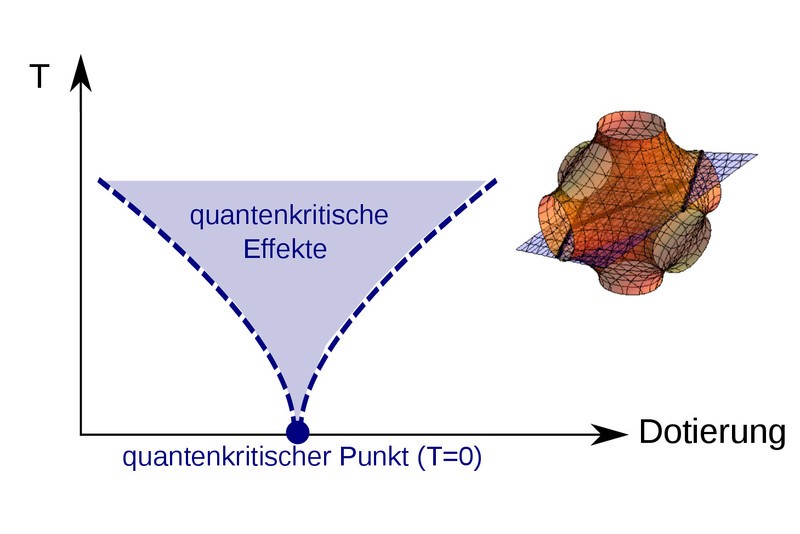
Illustration quantenkritischer Effekte
The peculiar characteristics demonstrated by 'quantum critical points' at absolute zero remain one of the great unsolved mysteries of science. Normally, there needs to be a change in temperature in order to see a phase transition: a liquid gets cold, it freezes; a metal heats up, it loses its magnetic properties. But there are some phase transitions in which the temperature cannot change, because they occur right at absolute zero. The quantum critical points where such transitions take place have been the subject of intensive research for many years, yet they are still hugely puzzling for quantum physicists. Until now, for example, there has been no comprehensive theoretical model for the high-temperature superconductivity that is suspected to be closely related to quantum critical points - although such a model could generate a lot of useful technical applications. Thomas Schäfer, Karsten Held and Alessandro Toschi of the Institute of Solid State Physics at TU Wien are working towards a better understanding of these phenomena, publishing their new ideas on this field in the journal "Physical Review Letters". Fluctuations: if it can shake, it will shake - "Thermal fluctuations are usually responsible for phase transitions," explains Thomas Schäfer.
TO READ THIS ARTICLE, CREATE YOUR ACCOUNT
And extend your reading, free of charge and with no commitment.