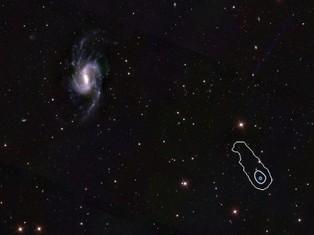
The Little Cub galaxy (circled) which is being stripped of gas by its larger neighbour. Credit: SDSS Collaboration
The Little Cub galaxy (circled) which is being stripped of gas by its larger neighbour. Credit: SDSS Collaboration A primitive galaxy that could provide clues about the early Universe has been spotted by astronomers as it begins to be consumed by a gigantic neighbouring galaxy. The Little Cub galaxy - so called because it sits in the Ursa Major or Great Bear constellation - is being stripped of the gas needed to continue forming stars by its larger companion. The find means scientists now have a rare opportunity to observe a dwarf galaxy as its gas is removed by the effects of a nearby giant galaxy to learn more about how this process happens. As the Little Cub has remained almost pristine since its formation, scientists also hope its elements will reveal more about the chemical signature of the Universe just minutes after the Big Bang. Cosmic feast The research has been carried out by Durham University, UK, and the University of California Santa Cruz, USA. The Little Cub and its larger neighbour, a grand design spiral galaxy called NGC 3359, are about 200 to 300 thousand light years apart, and approximately 50 million light years from Earth.
TO READ THIS ARTICLE, CREATE YOUR ACCOUNT
And extend your reading, free of charge and with no commitment.