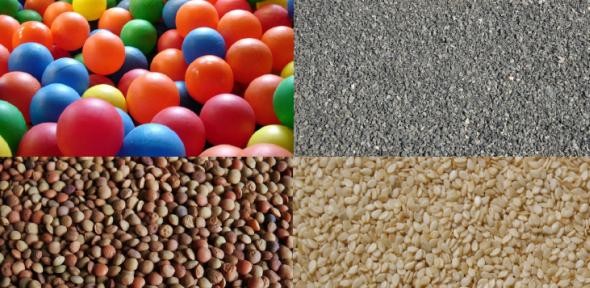
A huge range of materials are classified as granular - including sand, gravel, snow, nuts, coal, rice, barley, coffee and cereals. Globally, they are the second-most processed type of material in industry, after water.
Credit: Wikimedia Commons
For the first time, researchers have been able to test a theory explaining the physics of how substances like sand and gravel pack together, helping them to understand more about some of the most industrially-processed materials on the planet. Granular materials are so widely-used that understanding their physics is very important. Clearly, something very special is happening at the moment when grains pack together in this way. Stefano Martiniani At the moment they come together, the individual grains in materials like sand and snow appear to have exactly the same probability of combining into any one of their many billions of possible arrangements, researchers have shown. The finding, by an international team of academics at the University of Cambridge, UK, and Brandeis University in the US, appears to confirm a decades-old mathematical theory which has never been proven, but provides the basis for better understanding granular materials - one of the most industrially significant classes of material on the planet. A granular material is anything that comprises solid particles that can be seen individually with the naked eye. Examples include sand, gravel, snow, coal, coffee, and rice.
TO READ THIS ARTICLE, CREATE YOUR ACCOUNT
And extend your reading, free of charge and with no commitment.