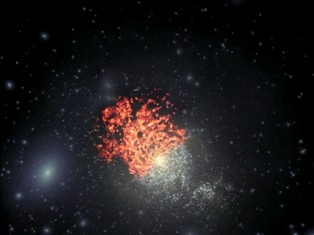
A simulated galaxy is pictured, showing the main ingredients that make up a galaxy: the stars (blue), the gas from which the stars are born (red), and the dark matter halo that surrounds the galaxy (light grey)
A simulated galaxy is pictured, showing the main ingredients that make up a galaxy: the stars (blue), the gas from which the stars are born (red), and the dark matter halo that surrounds the galaxy (light grey). Further evidence of the existence of dark matter - the mysterious substance that is believed to hold the Universe together - has been produced by Cosmologists at Durham University. Using sophisticated computer modelling techniques, the research team simulated the formation of galaxies in the presence of dark matter and were able to demonstrate that their size and rotation speed were linked to their brightness in a similar way to observations made by astronomers. One of the simulations is pictured, showing the main ingredients that make up a galaxy: the stars (blue), the gas from which the stars are born (red), and the dark matter halo that surrounds the galaxy (light grey). Alternative theories Until now, theories of dark matter have predicted a much more complex relationship between the size, mass and brightness (or luminosity) of galaxies than is actually observed, which has led to dark matter sceptics proposing alternative theories that are seemingly a better fit with what we see. The research led by Dr Aaron Ludlow of the Institute for Computational Cosmology , is published in the academic journal, Physical Review Letters. Most cosmologists believe that more than 80 per cent of the total mass of the Universe is made up of dark matter - a mysterious particle that has so far not been detected but explains many of the properties of the Universe such as the microwave background measured by the Planck satellite.
TO READ THIS ARTICLE, CREATE YOUR ACCOUNT
And extend your reading, free of charge and with no commitment.