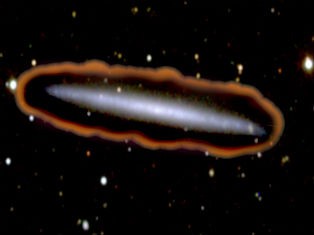
Fluorescence around galaxy UGC 7321 (M. Fumagalli/T. Theuns/S. Berry)
Universe's ultraviolet background could provide clues about missing galaxies. March 2017) Astronomers have developed a way to detect the ultraviolet (UV) background of the Universe, which could help explain why there are so few small galaxies in the cosmos. UV radiation is invisible but shows up as visible red light when it interacts with gas. An international team of researchers led by Durham University, UK, has now found a way to measure it using instruments on Earth. The researchers said their method can be used to measure the evolution of the UV background through cosmic time, mapping how and when it suppresses the formation of small galaxies. The study could also help produce more accurate computer simulations of the evolution of the Universe. The findings are published today in the journal Monthly Notices of the Royal Astronomical Society .
TO READ THIS ARTICLE, CREATE YOUR ACCOUNT
And extend your reading, free of charge and with no commitment.