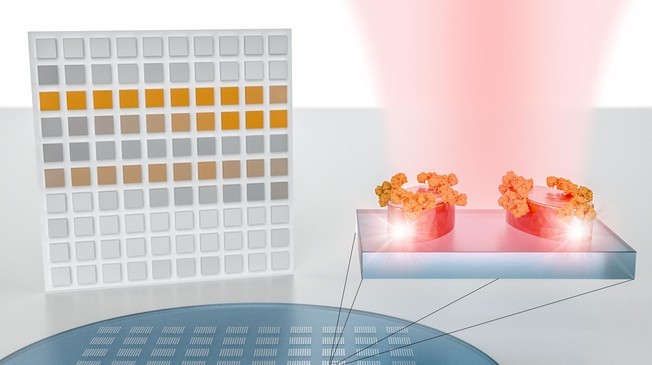
A new system developed at EPFL can detect and analyze molecules with very high precision and without needing bulky equipment. It opens the door to large-scale, image-based detection of materials aided by artificial intelligence. Infrared spectroscopy is the benchmark method for detecting and analyzing organic compounds. But it requires complicated procedures and large, expensive instruments, making device miniaturization challenging and hindering its use for some industrial and medical applications and for data collection out in the field, such as for measuring pollutant concentrations. Furthermore, it is fundamentally limited by low sensitivities and therefore requires large sample amounts. However, scientists at EPFL's School of Engineering and at Australian National University (ANU) have developed a compact and sensitive nanophotonic system that can identify a molecule's absorption characteristics without using conventional spectrometry. The scientists have already used their system to detect polymers, pesticides and organic compounds. What's more, it is compatible with CMOS technology. Their system consists of an engineered surface covered with hundreds of tiny sensors called metapixels, which can generate a distinct bar code for every molecule that the surface comes into contact with. These bar codes can be massively analyzed and classified using advanced pattern recognition and sorting technology such as artificial neural networks. Translating molecules into bar codes
TO READ THIS ARTICLE, CREATE YOUR ACCOUNT
And extend your reading, free of charge and with no commitment.
Your Benefits
- Access to all content
- Receive newsmails for news and jobs
- Post ads