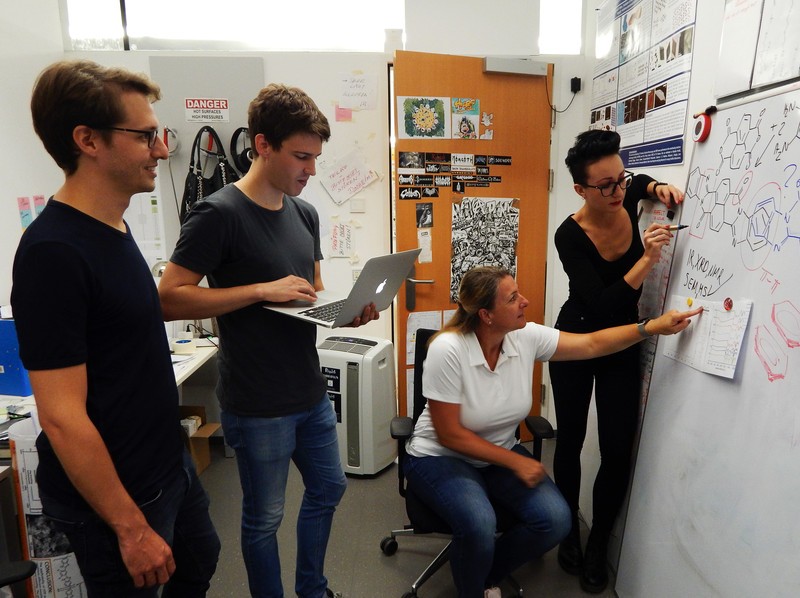
The team: Florian Glöcklhofer, Michael Josef Taubländer, Martina Marchetti-Deschmann and Miriam M. Unterlass discussing results.
Dyes that are also of great interest for organic electronics have recently been prepared and crystallised at TU Wien. All that is required is just water, albeit under highly unusual conditions. They not only impress due to their radiant and intense colour, they also have an important technological significance: organic dyes are a class of materials with extremely special properties. From flat screens to electronic paper through to chip cards: in future, many technologies are likely to be based on organic molecules like these. Previously, such materials could only be prepared using complex synthesis methods that are incredibly harmful to the environment. However, researchers at TU Wien have now successfully synthesized several typical representatives of this materials class in an entirely new and different way: toxic solvents have been replaced by plain water. But how is this done? When water is heated to extremely high temperatures, its properties change significantly.
TO READ THIS ARTICLE, CREATE YOUR ACCOUNT
And extend your reading, free of charge and with no commitment.