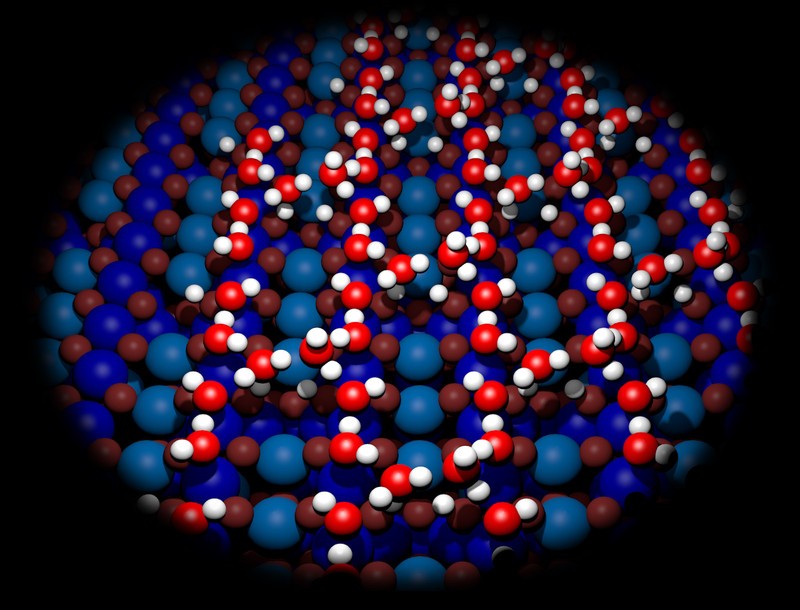
Wassermoleküle bilden komplexe Strukturen auf der Eisenoxid-Oberfläche
A team at TU Wien now has the proof behind the speculations that water molecules can form complex bridge-like structures when they accumulate on mineral surfaces. Water is an extremely complex liquid. The way in which separate water molecules accumulate on various materials has a crucial impact on a great many processes, including corrosion and weathering, and is key in ensuring that catalysts function optimally. A team based at TU Wien has now managed to uncover the mystery behind the structure of water molecules on iron oxide surfaces, and their work has revealed that water molecules can form of complex structures reminiscent of bridges, which play a significant role when it comes to chemical reactions on the surface. The special properties of water - "What makes water molecules unique is that they can form hydrogen bridge bonds," explains Prof. Gareth Parkinson from the Institute of Applied Physics at TU Wien. "The electrical charge distribution is not even. The oxygen atom is slightly negatively charged, whilst the hydrogen atoms are slightly positively charged." As a result, bonds can form between water molecules - the famous hydrogen bridge bonds - or even between a water molecule and other types of molecule.
TO READ THIS ARTICLE, CREATE YOUR ACCOUNT
And extend your reading, free of charge and with no commitment.