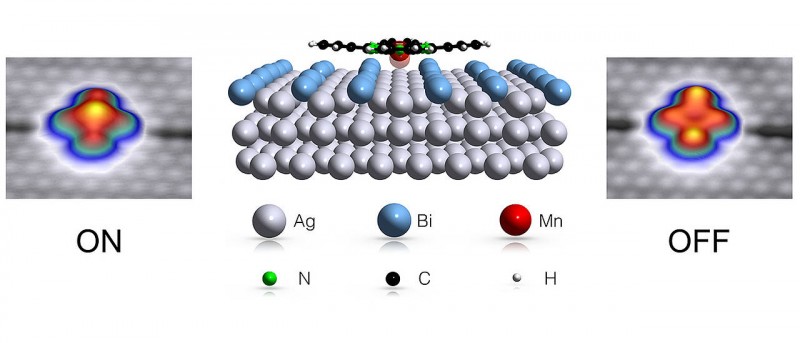
A flat molecule on a surface comprised of bismuth atoms (blue) and silver atoms (grey). The central manganese atom (red) is capable of changing its position. As a result, the molecule can take on two stable states. (Graphic: Jens Kügel & Michael Karolak)
11/14/2018 - For the first time, physicists from the University of Würzburg have successfully positioned an organic molecule on a substrate realizing two stable configurations. This may have application potential in molecular spintronics. It looks like a cross with four arms of equal length that have a central atom at their intersection. All atoms are arranged in one plane so that the molecule is absolutely planar - at least in the normal state. Physicists from the University of Würzburg have now succeeded in manipulating this molecule using a special deposit and an electrical field to permanently take on two different states. This could make the molecule suitable as a kind of "molecular switch" for spintronics applications - a trailblazing data processing technology based on electron spin. The molecular switch is the fruit of a collaboration of members from the Departments of Experimental and Theoretical Physics at the University of Würzburg: Dr. Jens Kügel, a postdoc at the Department of Experimental Physics II, devised and ran the experiments.
TO READ THIS ARTICLE, CREATE YOUR ACCOUNT
And extend your reading, free of charge and with no commitment.