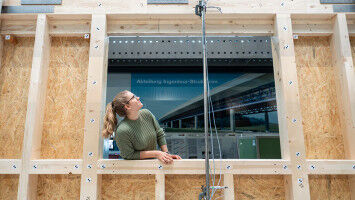
Experimental flooding: Eawag researchers collecting data to improve the modelling of flash floods in urban areas. (Photo: Andreas Scheidegger, Eawag)
Heavy rainfall can cause flash floods in urban areas. While data from flood events is required to model such phenomena, water levels and discharges are not routinely measured above ground. Eawag now plans to make use of widely available images and videos to estimate these values. We are all familiar with the chaotic scenes caused by torrential rain in towns - roads turned into raging rivers and sewers overflowing, unable to cope with the volume of water running off streets, squares and rooftops. In July 2017, for example, the historic old town of Zofingen (canton of Aargau) was completely inundated. Although modelling can be used to simulate flooding, the flood event data which is needed to calibrate, validate and improve computer models has been lacking to date. Generating such data is the goal of an Eawag project known as Calico (Calibration of Coupled urban flood models with experimental surface runoff data), which is supported by the Swiss National Science Foundation.
TO READ THIS ARTICLE, CREATE YOUR ACCOUNT
And extend your reading, free of charge and with no commitment.