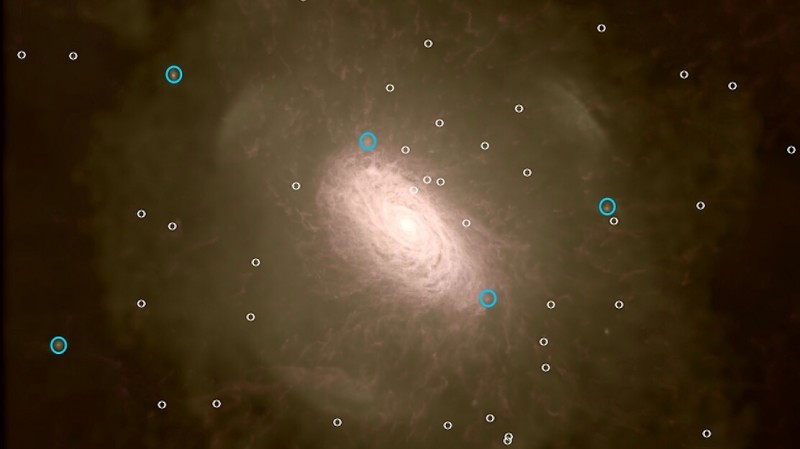
Bright galaxies (blue) and dim dwarf galaxies (white) orbiting a simulated galaxy’s center.
Graphic: : Durham University, University of Heidelberg and the Max Planck Institute for Astrophysics
Some of the faintest satellite galaxies orbiting our own Milky Way galaxy are amongst the very first that formed in our Universe, physicists have found. Findings by a team of academics, including physicists Professor Carlos Frenk and Dr Alis Deason from the Institute for Computational Cosmology (ICC) at Durham University and Dr Sownak Bose from the Harvard-Smithsonian Center for Astrophysics in America, suggest that galaxies including Segue-1, Bootes I, Tucana II and Ursa Major I are over 13 billion years old. Their findings are published in The Astrophysical Journal . Professor Carlos Frenk, Director of Durham University's ICC, said: "Finding some of the very first galaxies that formed in our Universe orbiting in the Milky Way's own backyard is the astronomical equivalent of finding the remains of the first humans that inhabited the Earth. It is hugely exciting. "Our finding supports the current model for the evolution of our Universe, the 'Lambda-cold-dark-matter model' in which the elementary particles that make up the dark matter drive cosmic evolution." Bursting into light Cosmologists believe that when the Universe was about 380,000 years old, the very first atoms formed. These were hydrogen atoms, the simplest element in the periodic table.
TO READ THIS ARTICLE, CREATE YOUR ACCOUNT
And extend your reading, free of charge and with no commitment.