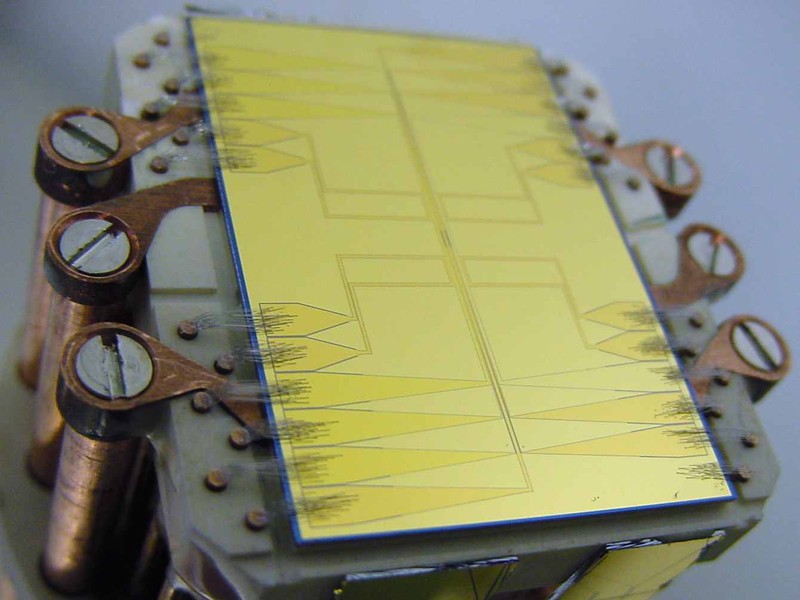
The atom chip at TU Wien
When quantum particles swirl about, they still obey universal laws. Different quantum systems can show the same behaviour - this has been demonstrated by two different experiments at TU Wien and Heidelberg University. Some things are so complicated that it is completely impossible to precisely calculate them. This includes large quantum systems, which consist of many particles, particularly when they are not in an equilibrium state, but changing rapidly. Such examples include the wild particle inferno that occurs in particle accelerators when large atoms collide, or in the early universe, just after the Big Bang, when particles rapidly expanded and subsequently cooled. At TU Wien and Heidelberg University, remarkable rules have been detected in the apparent chaos of disequilibrium processes. This indicates that such processes can be divided into universality classes.
TO READ THIS ARTICLE, CREATE YOUR ACCOUNT
And extend your reading, free of charge and with no commitment.