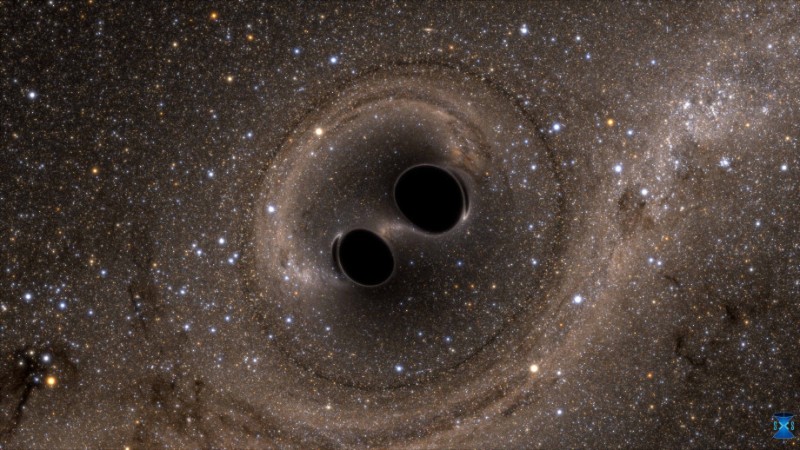
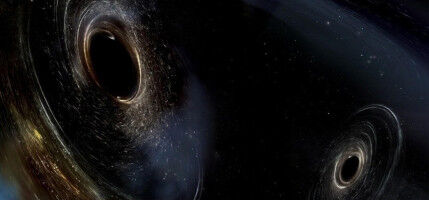
Artist's impression of a black-hole collision. Image credit: SXS
An international team of scientists have detected ripples in space and time, known as gravitational waves, from the biggest known black-hole collision that formed a new black hole about 80 times larger than the Sun - and from another three black-hole mergers. ANU is playing a lead role in Australia's involvement with the gravitational wave discovery through a partnership in the Advanced Laser Interferometer Gravitational-wave Observatory (LIGO), which is based in the United States. Professor Susan Scott, who is Leader of the General Relativity Theory and Data Analysis Group at ANU, said the team discovered the four collisions by re-analysing data from Advanced LIGO's first two observing runs. Scientists detected the event that formed the biggest known black hole from a merger of a binary system of two black holes on 29 July 2017. The event occurred about nine billion light years away. "This event also had black holes spinning the fastest of all mergers observed so far. It is also by far the most distant merger observed," Professor Scott said.
TO READ THIS ARTICLE, CREATE YOUR ACCOUNT
And extend your reading, free of charge and with no commitment.