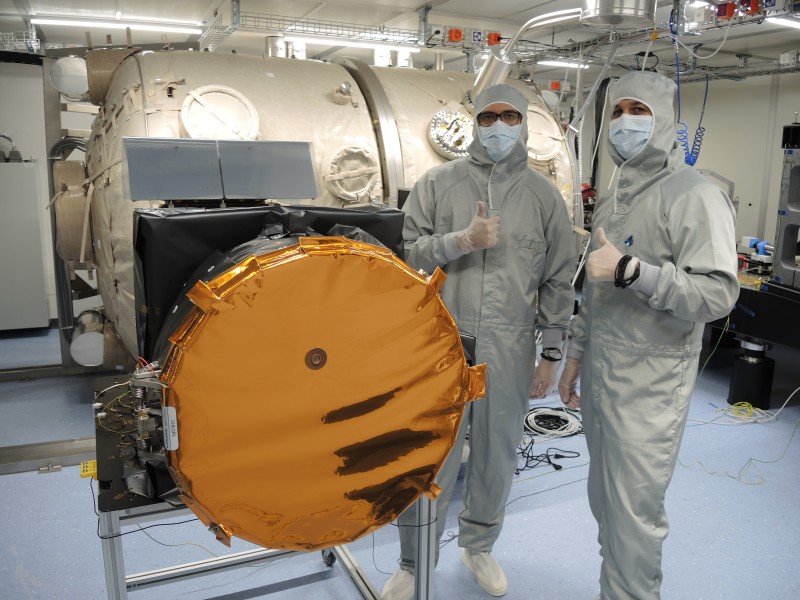
The CHEOPS telescope in the cleanroom of the University of Bern. Picture: Thomas Beck / Universität Bern
Construction of the space telescope CHEOPS is finished. The engineers from the Center for Space and Habitability (CSH) at the University of Bern will package the instrument this week and send it to Madrid, where it will be integrated on the satellite platform. CHEOPS (CHaracterising ExOPlanet Satellite) is to be ready to launch in early 2019 and will observe how exoplanets in other solar systems pass in front of their host star - assisting in the search of potentially habitable planets. The specially designed transport case is ready and waiting in the building for Exact Sciences of the University of Bern. In the next few days, the CHEOPS team will load the space telescope in the cleanroom into the transport container, where it is well protected against shock, moisture and dirt. A truck will then transport the precious cargo to Madrid. The company "Airbus Defense and Space - Spain" built the satellite platform that supports the telescope and enables it to operate in space. In the upcoming weeks the instrument will be integrated and the satellite will be tested. The space telescope will observe stars in our cosmic neighbourhood that are known to be orbited by exoplanets. CHEOPS measures the brightness of the stars. This decreases slightly when an exoplanet passes in front of its host star. The size of the exoplanet can be determined by the decrease in brightness during such a transit. "The instrument must be able to measure with extreme precision. This was the major design challenge," says Willy Benz, professor of Astrophysics at the University of Bern and Principal Investigator of the CHEOPS mission, which Switzerland is carrying out together with the European Space Agency (ESA). "We think that we meet the requirements, otherwise we would not be flying," says Christopher Broeg, project manager for the CHEOPS mission. Components from different countries
TO READ THIS ARTICLE, CREATE YOUR ACCOUNT
And extend your reading, free of charge and with no commitment.