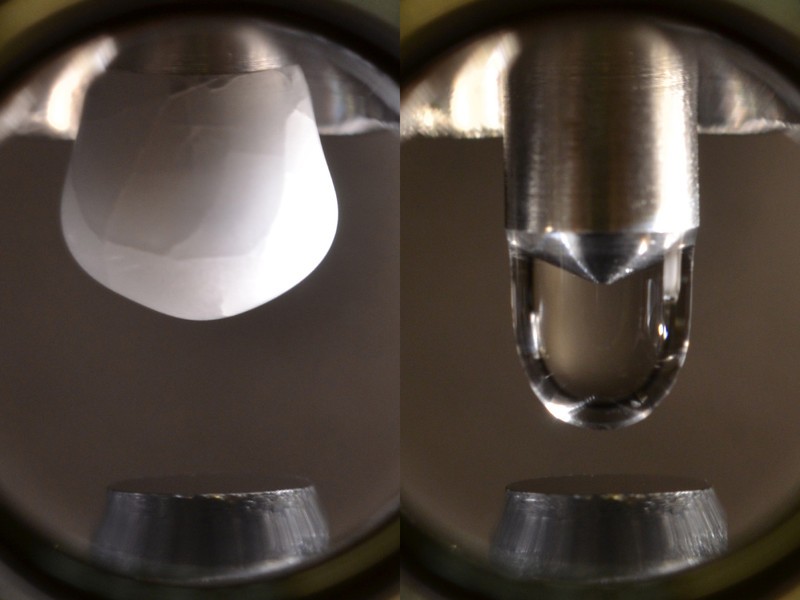
The ultraclean icicle (left) and the droplet, after melting.
What effect does water have on ultra-clean surfaces' Using a novel method, researchers at TU Wien and Cornell University have succeeded in demonstrating that smallest impurities can have a surprising effect. In nature there is no such thing as a truly clean surface. Contact with normal air is sufficient to coat any material with a thin layer of molecules. This "molecular dirt" can change the properties of the material considerably, yet the molecules themselves are difficult to study. Some have speculated that this "dirt" is simply a single layer of water molecules. To test this idea, a new investigation method has been developed at TU Wien: by creating ultra-pure ice in a vacuum chamber, and then melting it, researchers could create the world's cleanest water drops, which were then applied to titanium dioxide surfaces. With this method, the researchers have shown that the "dirt" changing the properties of titanium dioxide surfaces is a single-molecule-thick layer of two organic acids: acetic acid (which makes vinegar sour) and its close relative, formic acid.
TO READ THIS ARTICLE, CREATE YOUR ACCOUNT
And extend your reading, free of charge and with no commitment.