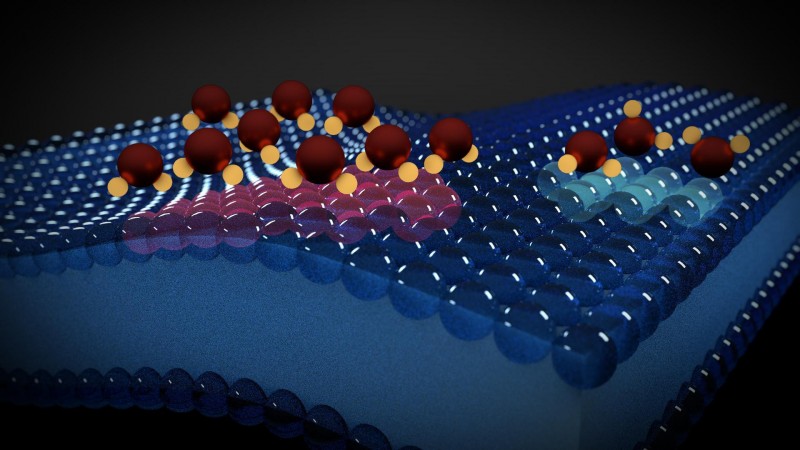
EPFL researchers were able to map out in real time how charges are transported across and along membranes simply by observing the behavior of adjacent water molecules. Their non-invasive and label-free method represents a valuable new tool in the effort to understand how cells - and neurons in particular - function. Every human cell is encased in a five-nanometer-thick lipid membrane that protects it from the surrounding environment. Like a gatekeeper, the membrane determines which ions and molecules can pass through. In so doing, it ensures the cell's well-being and stability and allows it to communicate via electrical signals. Researchers from the Laboratory for fundamental BioPhotonics (LBP) in EPFL's School of Engineering were able to track these moving charges in real time in a completely non-invasive manner. Rather than observing the membranes themselves, they looked at the surrounding water molecules, which, in addition to keeping the membrane intact, change orientation in the presence of electrical charges.
TO READ THIS ARTICLE, CREATE YOUR ACCOUNT
And extend your reading, free of charge and with no commitment.
Your Benefits
- Access to all content
- Receive newsmails for news and jobs
- Post ads