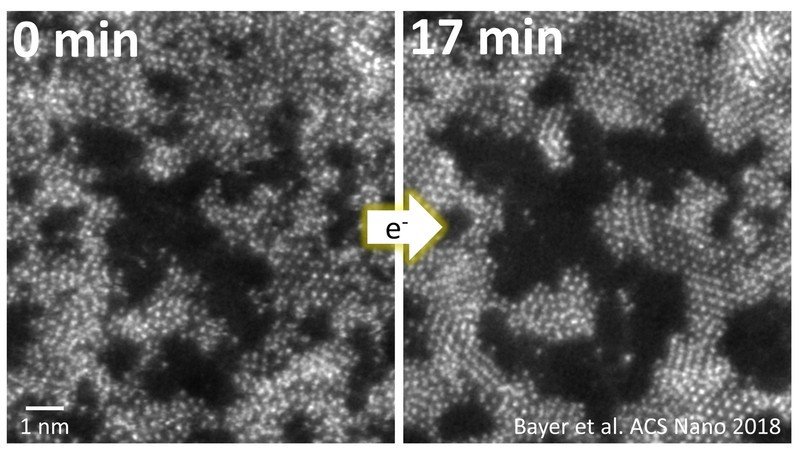
At first, the atoms are randomly distributed, after being manipulated with the electron beam, they form crystal structures (right)
Atomically thin crystals will play an ever greater role in future - but how can their crystallisation process be controlled? A new method is now opening up new possibilities. They are among the thinnest structures on earth: "two dimensional materials" are crystals which consist of only one or a few layers of atoms. They often display unusual properties, promising many new applications in opto-electronics and energy technology. One of these materials is 2D-molybdenum sulphide, an atomically thin layer of molybdenum and sulphur atoms. The production of such ultra-thin crystals is difficult. The crystallisation process depends on many different factors. In the past, different techniques have yielded quite diverse results, but the reasons for this could not be accurately explained.
TO READ THIS ARTICLE, CREATE YOUR ACCOUNT
And extend your reading, free of charge and with no commitment.