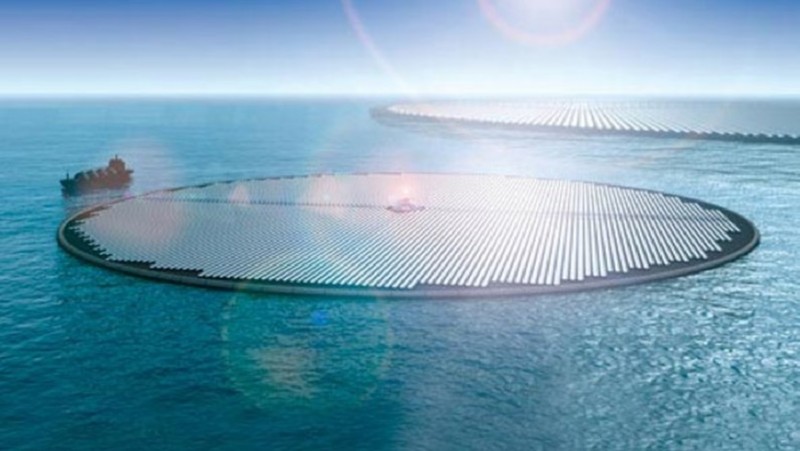
The floating solar islands could look like this. On the ship to the left are all the plants needed to produce methanol. Visualization: Novaton
Huge floating solar islands on the ocean that produce enough energy to enable CO2-neutral global freight traffic - what sounds like "science fiction" researchers from ETH Zurich, the Paul Scherrer Institute (PSI), Empa, the Universities of Zurich and Bern and the Nowegian University of Science and Technology (NTNU) in Trondheim have now calculated for the first time, as they write in the latest issue of the journal "Proceedings of the National Academy of Sciences" (PNAS). Paper, tin cans, glass - the world recycles as much as possible. So why not declare the greenhouse gas carbon dioxide (CO2) a recycling product as well? Liquid fuels based on carbon will continue to play an important role in the future - despite international efforts to reduce them. So it seems sensible to recover the CO2 exhaust from the environment and use it again. Researchers from ETH Zurich, PSI and the Universities of Zurich, Bern and the Norwegian University of Science and Technology (NTNU), together with a team from Empa, have calculated this idea and have shown that solar methanol islands could produce enough fuel in the long term to make all CO2 emitted from transportation sources neutral - worldwide. In the middle of the oceans, hydrogen (H2) is to be produced from solar energy (and water), which is then converted into methanol on site using CO2 extracted from the seawater.
TO READ THIS ARTICLE, CREATE YOUR ACCOUNT
And extend your reading, free of charge and with no commitment.