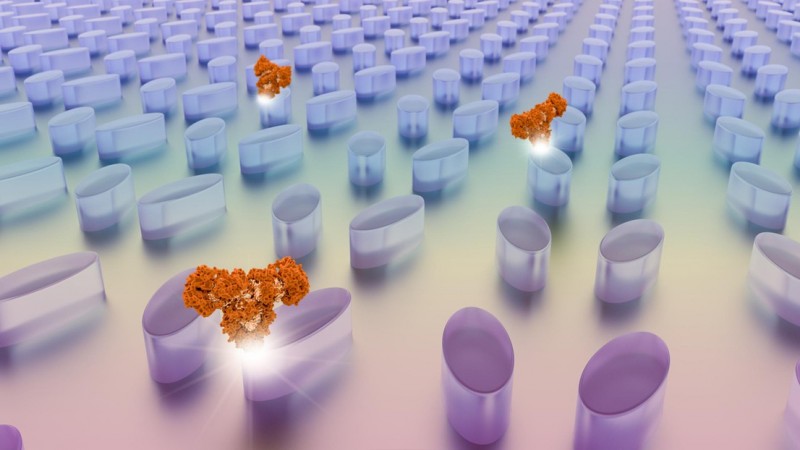
With nothing more than a photonic chip and an ordinary camera, EPFL researchers have managed to count biomolecules one by one in a small sample and determine their position. Their tiny device - a marriage of optics and smart image analysis - is even able to detect a graphene sheet only a single atom thick. This type of sensor could one day play a key role in personalized medicine. In the not-too-distant future, each of us may have a simple device - small enough for our nightstand or our pocket - that keeps us apprised of our level of health, identifies even trace amounts of undesirable biomarkers in our blood or saliva and serves as an early-warning system for diseases. This is one of the promises of personalized medicine. This technological revolution may be one step closer thanks to a powerful tool developed by researchers at EPFL's BioNanoPhotonic Systems (BIOS) Laboratory. It consists of an ultra-thin and miniaturized optical chip that, when coupled with a standard CMOS camera and powered by image analysis, is able to count biomolecules one by one in a sample and determine their location. Their research has been published . A very powerful sensor This pioneering technology is based on metasurfaces - rising stars in the field of photonics. Metasurfaces are sheets of artificial materials covered in millions of nano-sized elements arranged in a special way. At a certain frequency, these elements are able to squeeze light into extremely small volumes, creating ultrasensitive optical 'hotspots'. When light shines on the metasurface and hits a molecule at one of these hotspots, the molecule is detected immediately. In fact, the molecule gives itself away by changing the wavelength of the light that hits it. Scanning molecules and taking their picture
TO READ THIS ARTICLE, CREATE YOUR ACCOUNT
And extend your reading, free of charge and with no commitment.
Your Benefits
- Access to all content
- Receive newsmails for news and jobs
- Post ads